
TL;DR – What is Cloud PBX?
Cloud PBX has become the default choice for businesses that want a modern, flexible phone system without the burden of maintaining hardware. Instead of relying on an aging PBX tucked in a telecom closet, companies are turning to cloud PBX platforms that run in secure data centers, support remote teams, and scale instantly as they grow.
For MSPs and IT providers, understanding what cloud PBX is — and why adoption keeps accelerating — is now essential.
This guide breaks down how cloud PBX works, the benefits for growing businesses, and how platforms like Viirtue let MSPs launch their own branded cloud PBX services with enterprise reliability and high-margin recurring revenue.
If you are still managing a phone system in a telecom closet, you already feel the pain: expensive hardware, clunky updates, and no easy way to support remote work.
The market for cloud PBX is booming — from roughly $22.6B in 2025 to a projected $44.3B by 2030 — a sign that cloud-based phone systems are rapidly replacing legacy PBX hardware (360iResearch).
That is why so many leaders are asking a simple question: What is cloud PBX, and why is everyone moving to it?
In this guide, we will break down:
What cloud PBX actually is
How a cloud PBX works behind the scenes
Cloud PBX vs on prem PBX in plain language
Key features and business benefits
Why cloud PBX is such a strong play for MSPs
How Viirtue helps you launch or scale a branded cloud PBX offering
What is Cloud PBX Anyway?
Cloud PBX (cloud-based Private Branch Exchange) is a business phone system hosted in the cloud that routes and manages calls over the internet instead of using a physical PBX box on-site.
In a traditional PBX setup, you install hardware in your office that:
Connects to the public phone network
Manages extensions and internal calls
Routes external calls to the right users
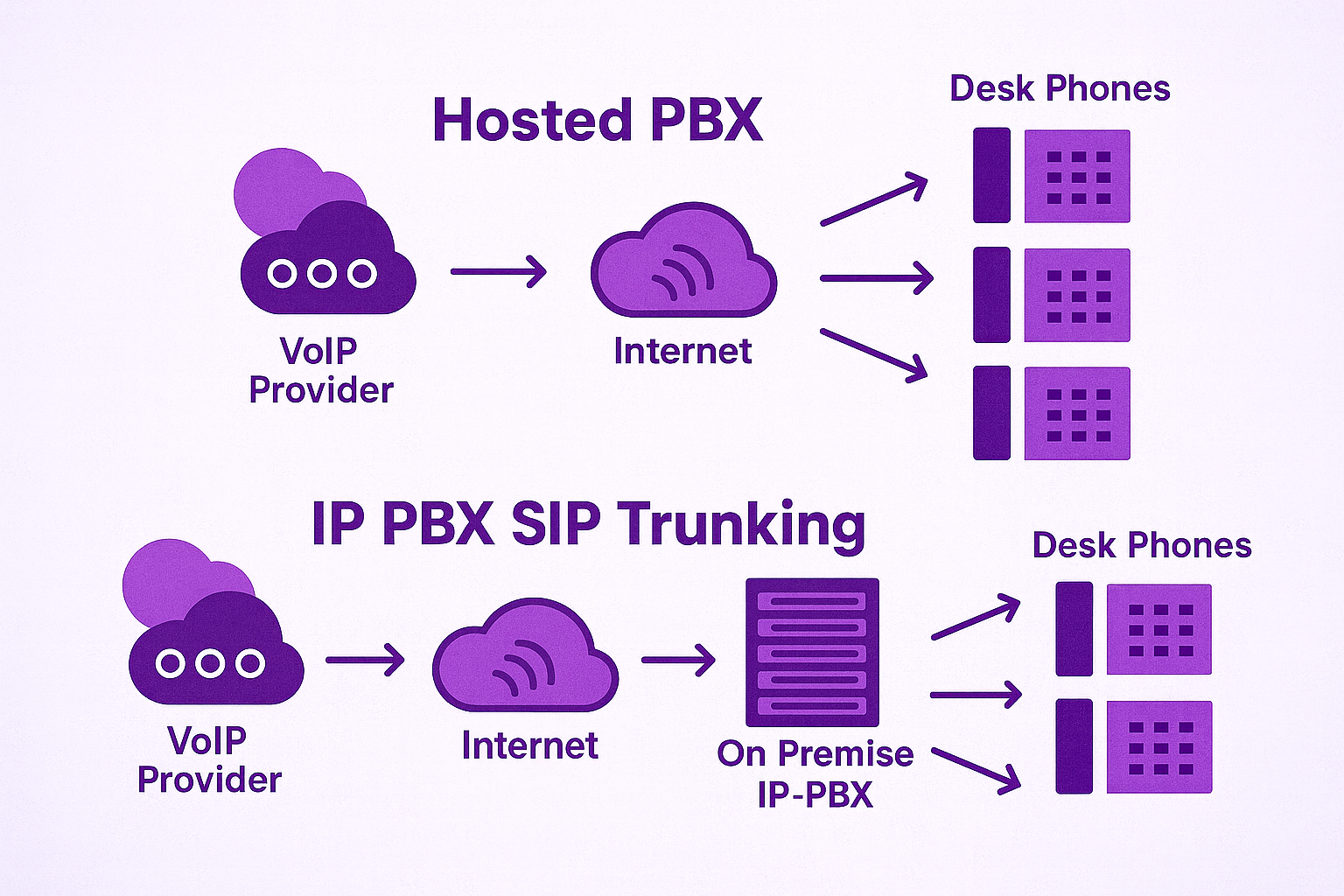
With cloud PBX, all of that call control and routing lives in a secure data center managed by a provider. Your users connect over the internet using desk phones, softphones, or mobile apps.
You will also see terms like:
Hosted PBX
Virtual PBX
Cloud phone system
Most modern vendors use these terms interchangeably. The core idea is the same: your PBX lives in the cloud, and you access it as a service.
For a deeper dive into hosted phone systems, see Viirtue’s article Hosted PBX Systems: The 2025 Buyer’s Guide to Replacing Legacy Phone Hardware.
How Does a Cloud PBX Work?
You do not need to be a telecom engineer to benefit from cloud PBX, but it helps to understand the basics.
Users register their devices: Employees use desk phones, softphones, or mobile apps that register to the cloud PBX platform over a secure internet connection.
The cloud PBX handles call control: When someone dials a number or extension, the cloud PBX decides how to route the call, which rules to apply, which ring groups or queues to use, and what happens if nobody answers.
The provider connects you to the public phone network: The cloud PBX platform connects to carriers and the public switched telephone network (PSTN), so you can call and receive calls from regular phone numbers.
Features and integrations run on the platform: Features like auto attendants, call recording, analytics, and CRM integrations all live in the cloud and apply to any registered device.
Monitoring, security, and failover are handled for you: The provider monitors uptime and call quality, applies security patches, and often includes geographic redundancy and failover options.
From the user’s perspective, it just feels like a modern business phone system that works anywhere and on any device.
Cloud PBX vs on-prem PBX
When customers search for what cloud PBX is, they usually also want to know how it compares to the old on-prem setup they already have.
Here is the short version.
Location and ownership:
On-prem PBX
Hardware lives in your office or data center
You buy, maintain, and eventually replace it
You handle upgrades and vendor support
Cloud PBX
PBX software runs in the provider’s cloud
You pay a subscription instead of owning hardware
The provider manages upgrades and infrastructure
Cost structure:
On-prem PBX
Higher upfront cost for hardware and licenses
Ongoing maintenance contracts and support fees
Upgrades can mean big one-time projects
Cloud PBX
Lower upfront cost
Predictable monthly or annual subscription
New features arrive as part of the service
Scalability and flexibility:
On-prem PBX
Adding capacity may require new hardware cards or modules
Multi-site deployments are complex
Supporting remote users often needs VPNs or extra gear
Cloud PBX
Add or remove users and numbers in a portal
New locations and remote workers are easy to onboard
Users can work from anywhere with an internet connection
Resilience:
On-prem PBX depends heavily on your building’s power and connectivity. If there is an outage, your phone system is down.
Cloud PBX lives in redundant data centers with built-in failover. Even if a local office goes offline, calls can still route to mobile devices, voicemail, or other locations.
Key Features of a Cloud PBX System
While individual offerings vary, robust cloud PBX (or “hosted PBX”) platforms tend to bundle a powerful suite of features that go well beyond “just making calls.” A mature cloud PBX typically includes:
Core call handling
Direct-inward-dial (DID) numbers and extensions. Each user can have a dedicated number or extension without needing physical line assignments — just a cloud-based profile.
Auto-attendants and IVR menus. Automated menus and prompts let callers self-route — e.g., “Press 1 for Sales, 2 for Support” — improving call flow and reducing manual receptionist burden.
Ring groups and hunt groups. Incoming calls can be distributed to a group of agents (e.g., sales or support), either simultaneously or in a specific order, to ensure fast response.
Call queues for basic contact center workflows. When call volumes surge, queues hold callers and distribute calls as agents become available — often with custom hold music or messaging.
Call forwarding, transfer, and park. Calls can be redirected — whether to a colleague’s desk, a mobile app, voicemail, or parked until retrieved — offering flexibility as employees move or change roles.
User-facing features
Voicemail (often with email delivery, and sometimes transcription). Voicemails don’t stay trapped on a desk phone — users can access them from email or mobile apps, ideal for remote or hybrid teams.
Caller ID, call history, and unified contact directory. Employees get context on incoming calls and easy lookup of internal or external contacts, improving professionalism and efficiency.
Call recording (on-demand or continuous — subject to compliance rules). Useful for compliance, quality control, training, or support documentation.
Support for multiple endpoints: desk phones, softphones, mobile, and desktop apps. Because the system lives in the cloud, users can dial in from anywhere — laptop softphone, mobile, tablet — not just a desk phone plugged into the wall. This is critical for remote and hybrid work.
Administration and reporting
Web-based admin portal. System admins get a central dashboard to configure extensions, routing rules, number assignments, and feature permissions — no on-site hardware or complex server management.
Role-based access and user permissions. Admins can assign different levels of access — say, standard user vs. supervisor vs. admin — ensuring security and operational clarity.
Call logs, analytics, and real-time dashboards. For teams handling high call volume or support tickets, managers can monitor queue depths, call volumes, wait times, agent performance, and more — enabling data-driven decisions and service quality improvement.
Integrations and advanced capabilities
CRM, help-desk, and business-app integrations. Cloud PBX systems often connect seamlessly to CRM tools, ticketing systems, collaboration suites, and more — allowing click-to-call, screen-pop on incoming calls, call logging, and unified communication workflows.
Unified communications (UC) capabilities — beyond voice. Many cloud PBXs offer (or integrate with) chat, video conferencing, team messaging, and file sharing, turning your phone system into a full communications platform.
APIs and custom workflows. For MSPs or tech-savvy teams, open APIs make it possible to automate workflows — e.g., hook call data into billing systems, trigger CRM events, or build custom reporting.
Platforms like Viirtue take this even further — packaging all those capabilities into a fully white-label cloud PBX/UCaaS stack built for MSPs. That means you’re not just inheriting someone else’s system — you’re delivering a polished, branded communication platform under your own name, complete with softphones, admin portals, billing integration, and the flexibility to support end-clients of any size.
See White Label Softphone for MSPs and Telcos for additional details.
Business benefits of cloud PBX
Cloud PBX aligns beautifully with what modern businesses need from communications, giving teams flexibility, control, and resilience — all while cutting costs and overhead.
1. Lower and more predictable costs
No PBX hardware to purchase, install, cool, or maintain — the infrastructure lives in the cloud.
You’ll avoid surprise repair bills, costly hardware upgrades, or depreciation — maintenance and updates are handled by the provider.
Pricing is often per user or per feature, making cost planning simpler and more predictable. Flexible pricing means you only pay for what you actually use.
Many businesses see overall telecom spend drop compared with legacy PBX, once you factor in maintenance, power, real-estate footprint for telecom closets, and ongoing licensing.
2. Support for remote and hybrid work
Cloud PBX is built for wherever your people are — home office, coffee shop, road trip, or traditional office desk.
Employees can answer business calls on laptops, mobile phones, softphones, or desk phones — no need to be physically tied to the office.
Remote workers get the same professional phone experience (extensions, caller ID, voicemail, call routing) as in-office staff, which keeps clients and internal teams connected even when distributed.
Admins and IT staff can manage the entire system via a web-based portal — configure call routing, add extensions, manage features — from anywhere, with no physical hardware on site.
3. Faster changes and easier expansions
Need to add new users, extensions, or phone numbers? With cloud PBX, onboarding is often a few clicks and minutes — no new hardware cards or waiting for installers.
Launching new departments, campaigns, or marketing lines becomes easier — you can build or adjust call flows, IVRs, ring groups, or queues without downtime or hardware shake-ups.
If your business opens a new location (or more than one), cloud PBX lets you connect all offices (and remote workers) under one unified phone system — no shipping, installing, or rewiring required.
4. Better reliability, resilience, and disaster recovery
Cloud PBX providers typically use geo-redundant data centers — if one server or location fails, calls fail over automatically to another. That means less downtime and more business continuity.
Because updates and patches are managed by the provider, you avoid periods of downtime for maintenance — no on-prem server reboot or manual firmware updates.
For multisite or remote-heavy teams, this resilience means even if a physical office loses power or internet, users on mobile or remote devices stay connected — calls can route to voicemail, mobile apps, or alternate devices seamlessly.
5. Easier compliance, security, and modern communications hygiene
Many cloud PBX platforms build in security features by default: data encryption (where supported), secure authentication, and regular security updates handled by the provider.
Because the system is centralized and managed by professionals, compliance–ready solutions (for call recording policies, data retention, disaster recovery, and regulatory requirements) become far simpler — especially helpful for regulated industries or MSP-managed environments.
Cloud PBX also tends to offer a more modern unified-communications experience — voice, voicemail-to-email, call routing, possibly video or messaging integrations — replacing a fragmented stack of legacy hardware, multiple vendors, and patchwork solutions.
Why Cloud PBX Is a Big Opportunity for MSPs
If you are an MSP or IT provider, cloud PBX is not just another SKU. It is a strategic anchor for your services.
Cloud PBX lets you:
Control an essential communication service your clients rely on daily
Wrap it in managed support and network services
Create sticky, high-margin recurring revenue
Viirtue’s older blog post 4 Requirements To Becoming A Cloud PBX Reseller walks through regulatory and operational requirements like FCC registrations, numbering, and taxes, which still matter if you try to build everything yourself.
The more practical path for most MSPs is to partner with a purpose-built cloud PBX and white label platform that already handles the hard parts.
How Viirtue Helps MSPs Launch and Scale Cloud PBX
Viirtue is the all in one white label VoIP and UCaaS platform built specifically for MSPs and IT providers, not end users.
Here is how Viirtue supports your cloud PBX practice.
1. Fully white label cloud PBX and UCaaS
With Viirtue, you can:
Offer cloud PBX and UCaaS under your brand
Keep Viirtue invisible to the end customer
Differentiate with your own bundles and service levels
Learn more on the White Label VoIP & UCaaS partner page.
2. ViiBE quote to cash platform
Cloud PBX revenue is only as good as your ability to bill and collect it accurately.
ViiBE gives you:
A quote to a cash platform for VoIP and other cloud services
Automated quoting, invoicing, and collections
A unified place to manage subscriptions and usage
You are not cobbling together separate quoting tools, billing systems, and tax engines.
3. Usage rating, telecom taxes, and compliance baked in
Telecom is notorious for tax and regulatory complexity. Viirtue’s stack includes:
Accurate usage rating for metered services
Automated telecom tax calculation and regulatory fees
A billing engine designed for MSPs and telecom resellers
For a deeper look, see How to Choose the Right Wholesale VoIP Provider in 2025 and Top 4 White Label VoIP Providers for MSPs in 2025.
4. Modern, mobile-first customer experience
Your customers expect a smooth, digital experience:
Branded portals to view invoices and service details
Mobile-friendly quote review and acceptance
Self-service options that complement your managed value
Viirtue’s platform is designed around MSPs delivering that experience.
5. A growth-focused partner program
Viirtue works only with partners, not end customers. That means:
No channel conflict
A partner program built around your growth
Marketing, training, and resources to help you position cloud PBX and UCaaS
See Why Viirtue’s White Label Reseller Program Stands Above the Rest for more on the partner model.
How to Choose a Cloud PBX Provider
If you are a business buyer or MSP evaluating platforms, look for:
Reliability and architecture
Redundant data centers
Strong uptime history
Clear disaster recovery story
Feature depth and integrations
Core PBX features plus queues, recording, and analytics
Integrations with your key tools (CRM, help desk, Teams, etc.)
Security and compliance
Encryption options
Strong authentication
Support for E911, recording policies, and industry-specific needs
Partner and support model
For MSPs: white label options, margins, and automation
For end customers: clear support structure and SLAs
If you want a more detailed checklist, pair this page with Viirtue’s Hosted PBX buyer’s guide.
Launch Your Own Cloud PBX Offering With Viirtue
If you are an MSP or IT provider and you want to:
Retire legacy on-prem PBX for your customers
Offer your own branded cloud PBX and UCaaS
Get out of the manual billing and telecom tax mess
Viirtue can help you launch quickly and scale with confidence.
Use one or more of these CTAs on the page:
See a cloud PBX and ViiBE demo
Talk to our team about your cloud PBX roadmap
Ready to move your customers to cloud PBX under your own brand?
Become a Viirtue partner or talk with our team about your voice and UCaaS roadmap.
FAQ: Cloud PBX
What is cloud PBX in simple terms?
Cloud PBX is a business phone system hosted in the cloud instead of on hardware in your office. Your provider runs the PBX software in secure data centers, and your users connect over the internet using desk phones, softphones, or mobile apps. You get business phone features as a subscription service rather than owning the PBX hardware yourself.
Is cloud PBX the same as hosted PBX?
In practice, yes. Most modern providers use cloud PBX, hosted PBX, and virtual PBX to describe the same concept: a PBX that runs off-site and is delivered over the internet. The exact wording is less important than the architecture, reliability, features, and support model.
How is cloud PBX different from VoIP?
VoIP is the underlying technology that carries voice over IP networks. Cloud PBX is a full phone system built on top of VoIP that includes features like auto attendants, queues, voicemail, call routing, and integration with other tools. You can think of VoIP as the transport and cloud PBX as the full system that uses it.
What are the main benefits of cloud PBX over on prem PBX?
Cloud PBX reduces upfront hardware costs, simplifies maintenance, and makes it easier to support remote and multi site teams. You pay a predictable subscription instead of buying and maintaining PBX hardware, and you can add or remove users quickly as your business changes.
Who should use cloud PBX?
Cloud PBX is a strong fit for:
Small and midsize businesses that want a modern phone system without managing hardware
Multi-site or remote heavy organizations that need one phone system across locations
Companies that are already moving other workloads to the cloud and want phones to follow
How can MSPs make money with cloud PBX?
MSPs can build their own branded cloud PBX offers on top of a white label platform like Viirtue. They control pricing and packaging, combine voice with other managed services, and own the monthly recurring revenue. Viirtue provides the underlying softswitch, automation, billing, and telecom tax handling so MSPs can focus on sales and support.
What do we need before moving to cloud PBX?
You should have:
Reliable internet with enough bandwidth for your concurrent calls
A quick network assessment to confirm it can handle voice traffic
A plan for endpoints such as IP desk phones, headsets, or softphones
A good MSP or cloud PBX provider will guide you through assessment, number porting, and migration so your cutover is as smooth as possible.